

I Went to Shoot a Hot Sauce Label. I Left With an Origin Story I Couldn't Stop Thinking About
Story and photos by Heidi Roth - August 8, 2026
Why HOTBABE-HOTSAUCE is picking peppers over scale
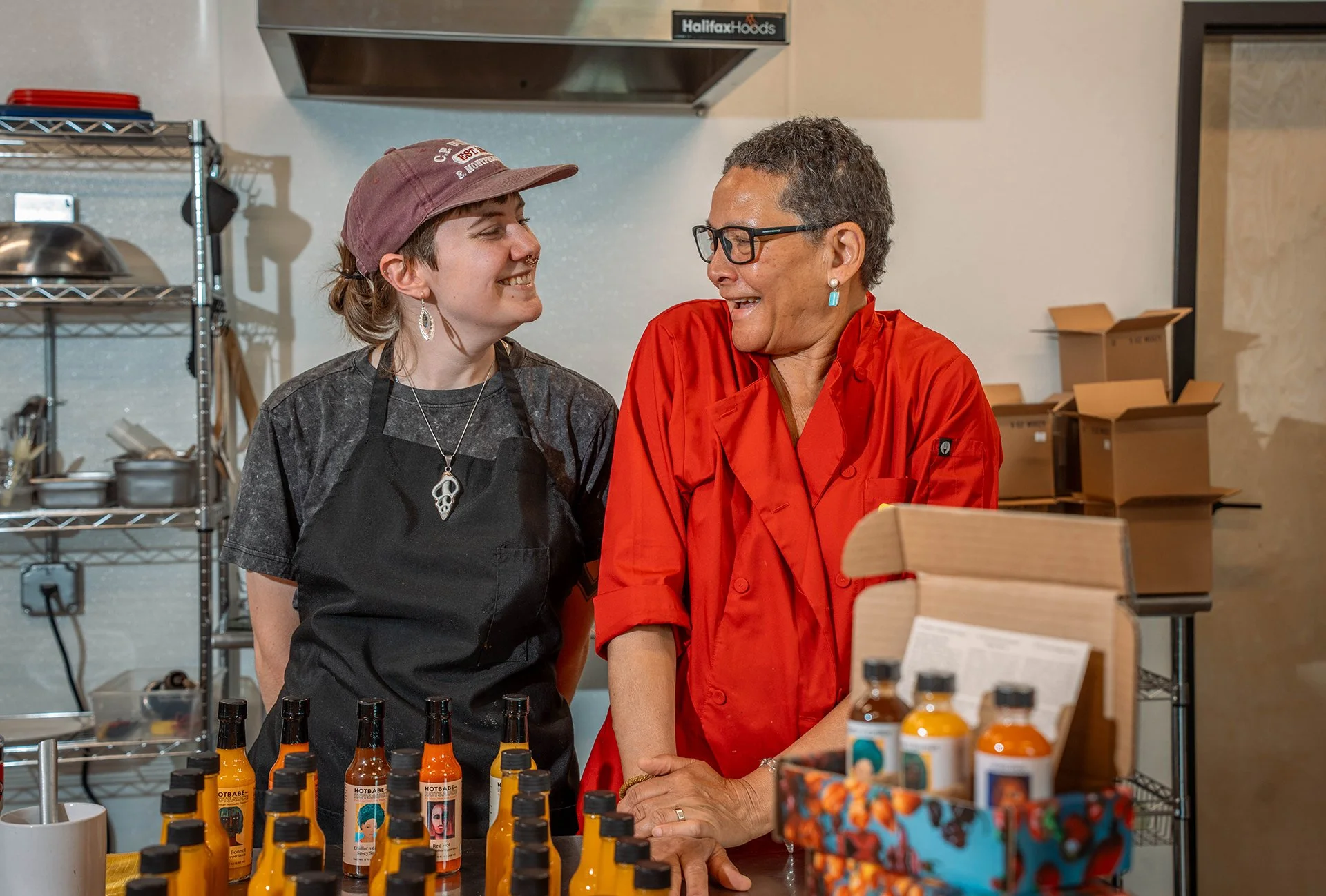
Oftentimes, doing work for one client puts me happily in the path of other people creating something special, which is what happened recently when I stopped into HOTBABE-HOTSAUCE’s production facility at the Agricultural Innovation Park in Tenino.
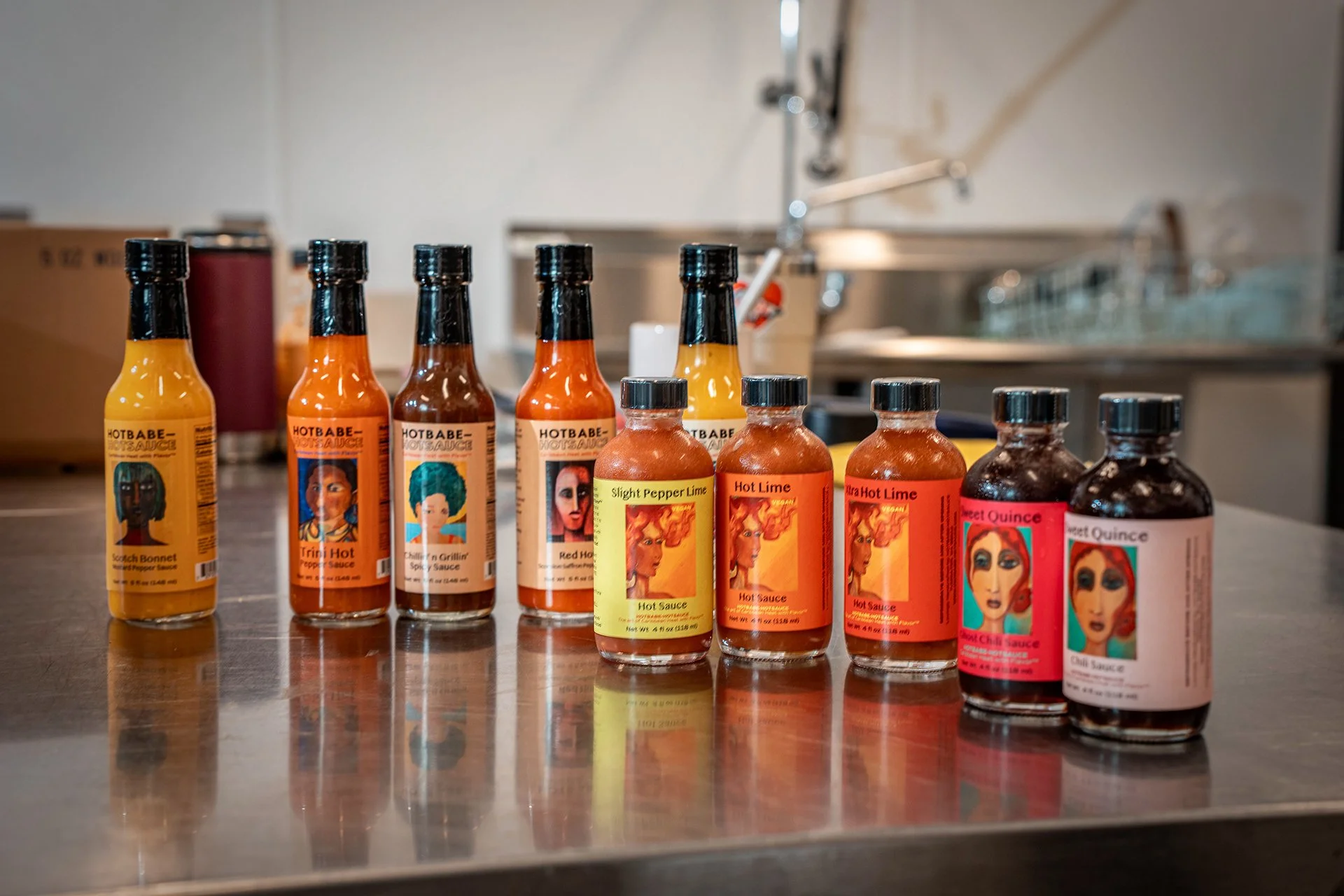
Sandra Bocas invited me to pop in as they bottled their Scotch Bonnet Mustard Pepper Sauce, one of the eight sauces she and her business partner Fiona have developed over time since starting with her grandmother’s original lime-based recipe. It’s not simply about getting some good light on on a product, asking a few questions about the business, then getting a quick quote I can drop into a caption before I bounce. I wanted to understand the “why” behind this vibrant hot sauce to provide the background that would direct the images I captured for an upcoming social media spotlight for Colvin Ranch Provisions.
Jennifer Colvin decided early on that the products she sold at their retail shop—a space where they could sell their own product as well as other locally made goods—have to follow strict guidelines: Products on the shelves must be grown, raised, and made in Southwest Washington. This goes for prepared foods as well. The ingredients must be local or regional, and the processing should be local or regional. HOTBABE-HOTSAUCE was a natural fit.
In an hour and a half, I got three generations worth of hard-won knowledge from Sandra telling me about her parents’ restaurant and her grandmother’s recipe in a way that made me forget I was holding a camera, and a very strong suspicion that I was going to owe this story more than just an Instagram caption.
So here we are. Consider this the long version.
The short version, for context
HOTBABE-HOTSAUCE is a Caribbean hot sauce company operating out of the Agricultural Innovation Park in Tenino, and one of the places they sell is at Colvin Ranch Provisions, which is how I ended up in their kitchen in the first place. I met with Sandra, who started the company and has trained Jonah to run production; and Lindy, who helps with sales and, as it turns out, is the reason Jonah works there at all. Though not in the kitchen that day, Fiona, Sandra’s business partner, is the one keeping everything ticking along smoothly.
I went in thinking I’d ask my usual questions. What do you make, how’d you start, what makes it special? Standard stuff. I did not expect to leave rearranging my whole week so I could write this instead.
It starts with a grandmother, obviously
Sandra grew up around her parents’ restaurant, El Diamante Negro—Spanish-Creole food, though she’s quick to tell you she claims her Trinidadian side more than her Venezuelan one, because that’s the culture that actually defined her palate. When I asked what she remembered most about it, Sandra didn’t talk about a recipe. She talked about how Ma taught her to have reverence for the food they created.
That’s the word Jonah used, actually, mid-sentence, filling in for Sandra like they’d had this exact conversation a hundred times before. A reverence for the food. “There’s a life force in what you’re making,” Sandra told me. A privilege in being the person trusted to make it for someone else to eat. Her family’s understanding of food goes back generations—the kind of knowledge that isn’t written down anywhere because it’s been graciously passed down through the years.
I’ve know a lot of people who are rightfully “passionate” for their product. This was not that. This reverence was something a bit closer to a mantra for this tight-knit crew.
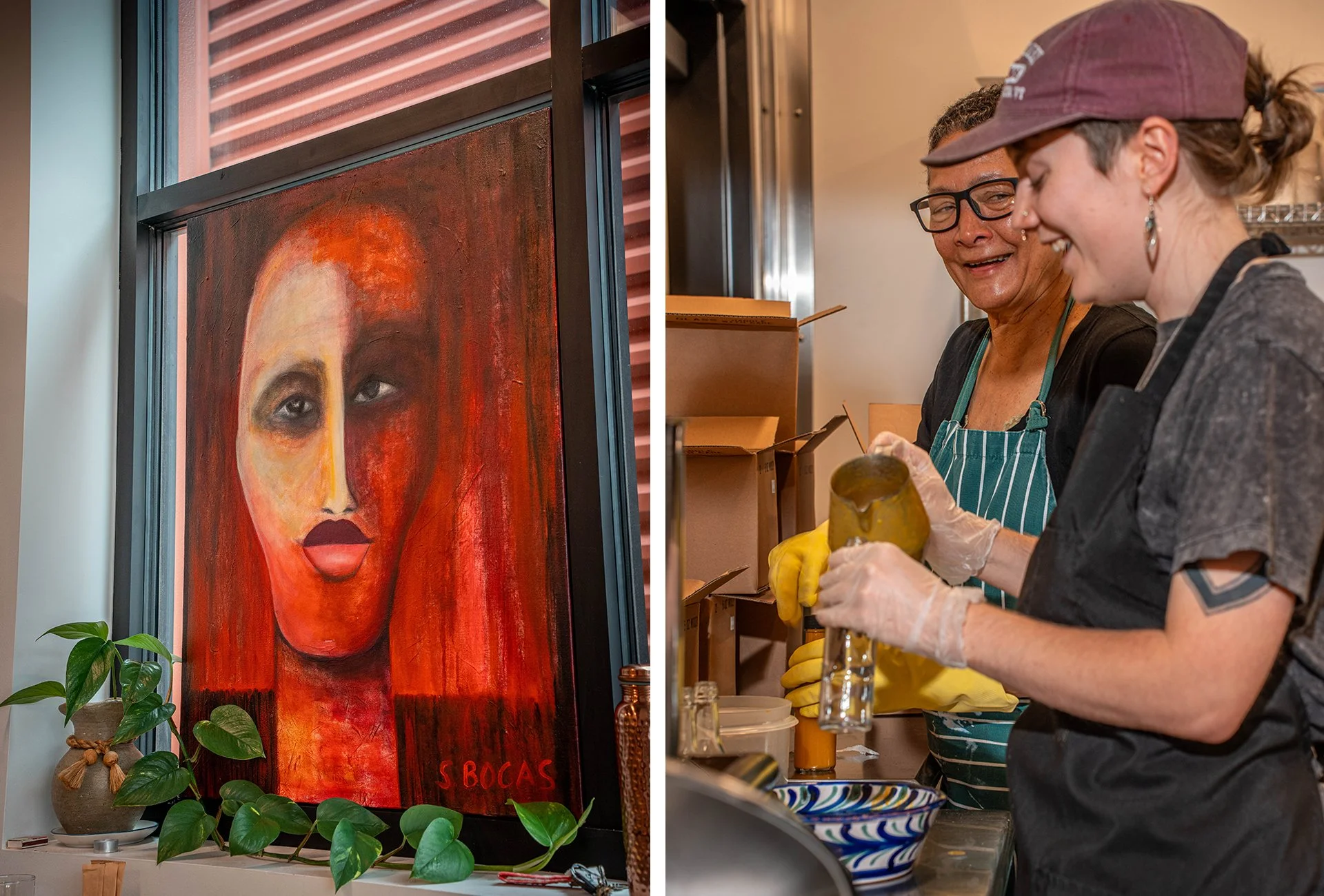
Sandra paints the artwork for every single label herself. Bright, saturated, and unmistakably hers. She told me color is “when my soul talks,” and she grew up in a place where that makes sense. Each label has a name and, apparently, a story she’s not quite ready to tell me yet. I’ll take that as a future excuse to come back.
The peppers are the whole business, and also the whole challenge
As Sandra talked me through their process, I didn’t expect a hot sauce company’s biggest vulnerability to be agricultural. Sandra and Fiona don’t buy pepper mash from a distributor. Nor do they use pepper extracts or powders. They only use fresh peppers grown exclusively for them on two small farms in Rochester and Yelm. And honestly, you can taste the difference. People do, apparently, constantly, at farmers markets. That “oh my god” reaction isn’t a fluke. It’s the flavors of fresh Caribbean peppers that most people have simply never had that before. For those that have tasted Caribbean hot sauces through their travels, they immediately recognize the ‘real ting’.
But peppers are seasonal. Late summer into fall, and that’s it—the plants need the whole spring and summer just to build up the strength to flower and fruit. So the team freezes what they harvest and builds their year-round production around that stockpile. Jonah put it plainly: if they run out of pepper, they can’t make sauce. Their growth as a company is tied to the harvests of their local farmer partners, which is a genuinely unusual problem to have, but one they’ve chosen on purpose. They could scale faster buying peppers from the east coast. They don’t want to.
The HOTBABE-HOTSAUCE ethos is one decision, really: quality and locality aren’t negotiable, even when it would be easier and more profitable to negotiate them.
Jonah, Lindy, and the job that found both of them
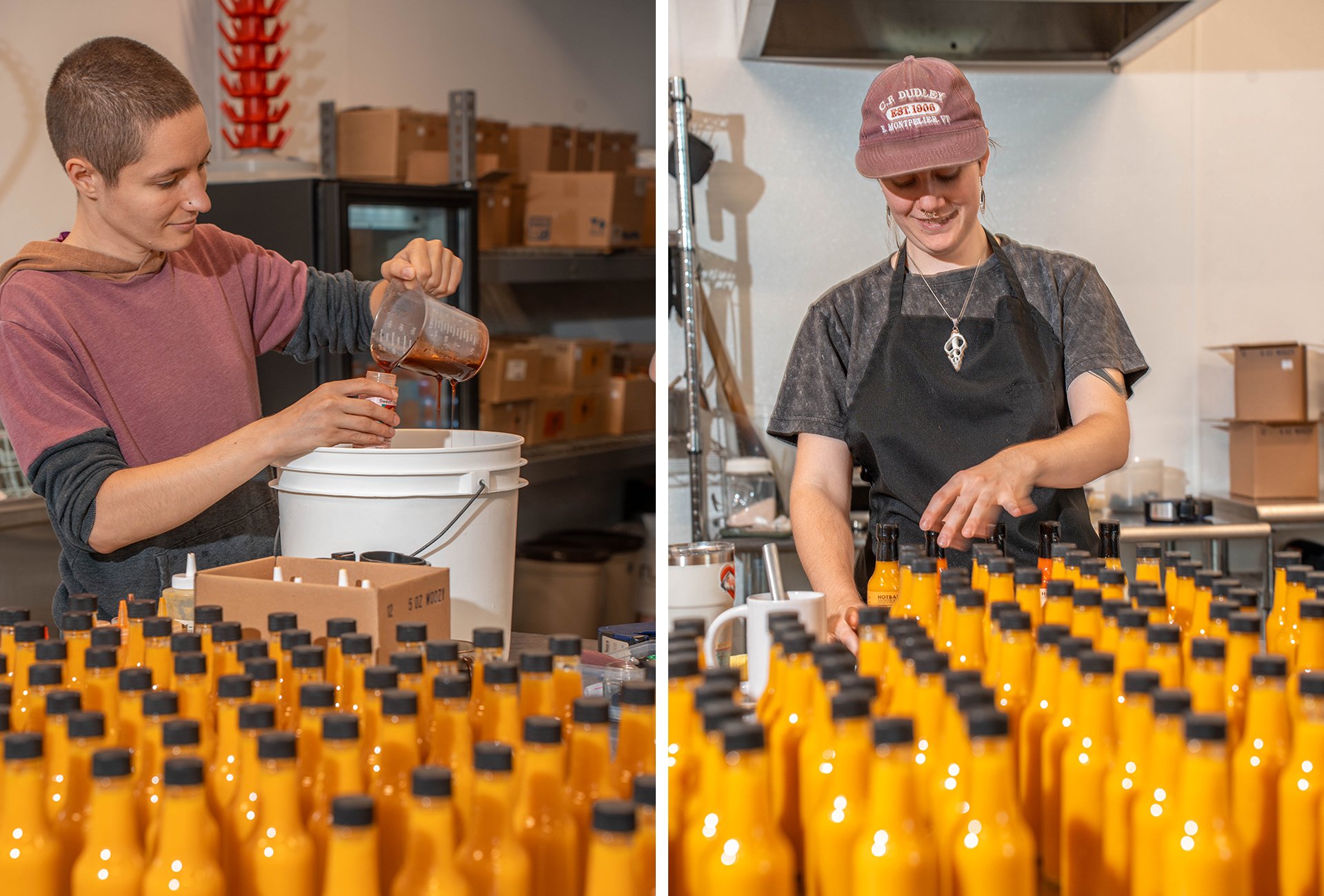
Jonah began training at the farm in 2024 by a grower named Judy who’s since retired, and worked their way into running the entire production process—prepping, cooking, bottling, labeling, shipping, inventory, more or less solo most days. Sandra talks about Jonah the way you’d talk about someone who totally gets it: they didn’t have to be taught to respect the food because just already did.
Lindy is the connective tissue in this story. She was the one who originally got Jonah the job, back when Jonah was bouncing between seasonal farm gigs and needed something that lined up with hot pepper harvest season. Now Lindy handles sales and gets to watch from the outside as the harvest numbers come in each year, which she talked about with something close to reverence herself—what did we get this year, and what do we do with it. Lindy and Jonah moved to Tenino together last year, and their daily transit is just three minutes from the Ag Park. Lindy called it “destined.” I don’t think she was exaggerating.
No shortcuts, no apologies
At some point Sandra told me, almost offhand, that when she and Fiona started this, they made one promise: they’d never sell anyone something they wouldn’t eat themselves. No gums, no preservatives, none of what she called “the bad stuff.” It takes them about a year to develop a new sauce—creating it, tasting it, adjusting, waiting, tasting again—because getting it right matters more than getting it out the door.
They’ve sold out of flavors before and just... told people. Sorry, we won’t have that particular sauce until the next harvest. When it happens, it’s not a supply chain problem to them. It’s just part of the reality of working with fresh, local ingredients.
Before I left, Lindy walked me through a tasting from mildest to hottest, ending on the Scotch Bonnet Mustard Pepper Sauce they were bottling that day. I’ve had plenty of hot sauce but I was not prepared for this. Yes, these sauces bring the heat. But I’ve never tasted a hot sauce this fresh, this full of flavor. Hot isn’t really the word I want. Bright is closer. Every one of them tasted like something that was picked, not processed.
Why I’m telling you this
I went to the Ag Park to do a job: get a nice photo, a nice quote, a nice vendor spotlight post for Colvin Ranch Provisions’ feed (link) because we love sharing those stories with our followers. That’s still going to happen. But somewhere in that kitchen, listening to Sandra talk about reverence and Jonah talk about pepper access like it was a moral position and Lindy talk about moving three minutes from work like it was fate, I remembered why I do this work in the first place.
This is exactly the kind of story I started Crunch Creative to tell. Small, stubborn, values-first businesses who are too busy actually doing the thing to explain why it matters—and who, when you finally get them talking, hand you something so much bigger than a highlight post.
HOTBABE-HOTSAUCE is carried at Colvin Ranch Provisions if you want to taste what I’m talking about. And if you’re ever the kind of person who ends up crashing a twenty-minute interview into an hour and a half because the story wouldn’t let you leave, I’d love to hear about it.
